EV News, Buying Guides
Nov 23, 2026
Read Story EV Battery Safety in Nepal: What Buyers Should Check
EV fires and weak battery rules are in the news. Check warranty, certification and charging habits before you buy an electric car in Nepal.
How many EV charging stations Nepal has, who runs them, what charging costs per unit, and how to plan a trip. Latest figures with charts.
Go With EV Editorial
Go With EV Editorial
Charging is the first question most people ask before buying an electric car in Nepal. The short answer is that the network has grown quickly, but the published numbers do not all measure the same thing. One count uses stations, another uses DC chargers and another uses individual charging guns. This guide collects the latest figures with their dates, explains who operates the stations, what NEA charges for electricity, and how to plan home and highway charging.
Different sources give very different totals, and the gap comes from what they count.
Reported charging stations in Nepal. Sources: Meroauto (18 July 2025) and Kantipur (17 October 2026).
| Date | Reported stations | Source |
|---|---|---|
| Before FY 2024/25 (Meroauto: about 1,200 until the previous fiscal year) | About 1,200 | Meroauto, 18 Jul 2025 |
| July 2025 | 1,511 | Meroauto, 18 Jul 2025 |
| 17 Oct 2026 | About 2,300 | Kantipur |
The practical reading is that thousands of charging points exist, but the number you can find on a map and rely on is smaller. Use a map or app to confirm that a specific charger is working before you depend on it.
NEA operates 62 stations according to Kantipur, Meroauto and Omoda Jaecoo Nepal. In September 2023 it switched on 51 rapid stations along highways, at bus parks and in major cities, including two at Dharke in Dhading, one each at the Chitwan, Muglin and Pokhara bus parks, and four in Kathmandu. Each has a 142 kW charger, a 50 kVA transformer and online billing, with 60 kW DC and 22 kW AC chargers so three vehicles, including a bus, can charge at once. The investment was about Rs 400 million, funded by NEA, an Asian Development Bank concessional loan and Norwegian technical assistance. Payment is by QR code or mobile app. In 2022 NEA also signed an agreement with Nepal Police to build stations at 25 police locations.
Meroauto's April 2025 article lists operators of DC chargers: CG Motors with 290 DC chargers (260 GBT and 30 CCS-2 sites, from Panchthar in the east to Baitadi Bazaar in the west), MAW with CCS-2 chargers at 96 locations, and Tata Motors, BYD and Omoda/Jaecoo with about 30 DC stations each. The article says the operator figures do not add up to the total. Omoda Jaecoo Nepal's guide names ElectriVa with over 50 stations and chargers from 30 to 180 kW, and AirCharge with 16 or more high-speed stations and over 200 guns. A Techmandu list also names BYD, Hyundai, Tata, Kia, MG, Thee Digo, Yatri and ElectriVa, and warns that some sites may be out of service.
A study by NEA, reported by Republica, broke down where stations are located. The Republica article gives its date only as "May 21" with no year, and its total of 750 stations is older than the figures above, so treat the mix as a rough guide.
Share of stations by site type. Source: NEA study reported by Republica (undated).
| Site type | Share of stations |
|---|---|
| Public areas | 41% |
| Hotels | 18% |
| Auto workshops | 17% |
| Restaurants | 13% |
| Petrol pumps | 8% |
| Other | 3% |
Public areas lead at 41%, followed by hotels at 18% and auto workshops and garages at 17%. Petrol pumps hold only 8%. On highways, NEA plans stations every 60 km on the East-West Highway, Madan Bhandari Highway and Mid-Hill Highway, and a Rs 2 billion plan to add 500 stations has been reported. The reports do not give a completion date, so these are plans and not confirmed coverage.
EV News Nepal, citing the Electricity Regulatory Commission tariff order and NEA, lists the rates below, checked on 14 October 2026. They are ceilings and the page does not give actual prices at each station.
NEA EV tariff to stations and the maximum retail price at a 20% markup. Source: EV News Nepal (checked 14 October 2026).
| Time of day | NEA rate to station (Rs per unit) | Retail ceiling (Rs per unit) |
|---|---|---|
| Normal (5 am to 5 pm) | 10.30 | 12.36 |
| Peak (5 pm to 11 pm) | 11.70 | 14.04 |
| Off-peak (11 pm to 5 am) | 5.15 | 6.18 |
Charging in the 11 pm to 5 am window cuts the unit price roughly in half, which matters if your station offers it. The figures are ceilings, so ask your station whether it offers an off-peak price.
NepalEVs counts 589 CCS2 guns, 508 GB/T guns and 84 AC guns. GB/T is the Chinese standard, so check which connector your car uses before relying on a network. Omoda Jaecoo Nepal estimates a home wallbox setup at about NPR 20,000, depending on wiring and property, and recommends a qualified electrician and a separate circuit.
The apps named by Omoda Jaecoo Nepal are NEA Charge, NepalEVs, GadiCharge, ElectriVa and AirCharge (EI Charge). Use at least one map app and one operator app on any long trip.
Corridors with charging noted in the guide include Kathmandu to Pokhara, Kathmandu to Chitwan and parts of the East-West Highway. A few habits help:
If you drive mainly in a city and can charge at home, the public network matters less. If you travel between cities, confirm that your route has chargers for your connector and check which operator networks need their own app. Compare range and charging details for each model on GoWithEVs.
Kantipur reported about 2,300 on 17 October 2026, including 62 run by NEA. Earlier, Meroauto reported 1,511 in July 2025. Map listings show fewer, for example 354 on NepalEVs.
NEA sells electricity to stations at Rs 5.15 to Rs 11.70 per unit depending on time of day, and retail prices are capped 20% above that, at Rs 6.18 to Rs 14.04.
About 28 to 45 minutes for 30% to 80%, according to Omoda Jaecoo Nepal's guide.
CCS2 and GB/T for DC charging, and Type 2 for AC. Check which one your car has.
Yes. A portable cable works with a household socket, and a Level 2 wallbox of 7 to 22 kW charges faster.
Explore trending electric vehicle news and upcoming launches
EV fires and weak battery rules are in the news. Check warranty, certification and charging habits before you buy an electric car in Nepal.
Best selling electric cars in India October 2026: Tata Punch EV, Mahindra XEV 9S, Nexon EV, Windsor EV sales, registrations and EV market share.
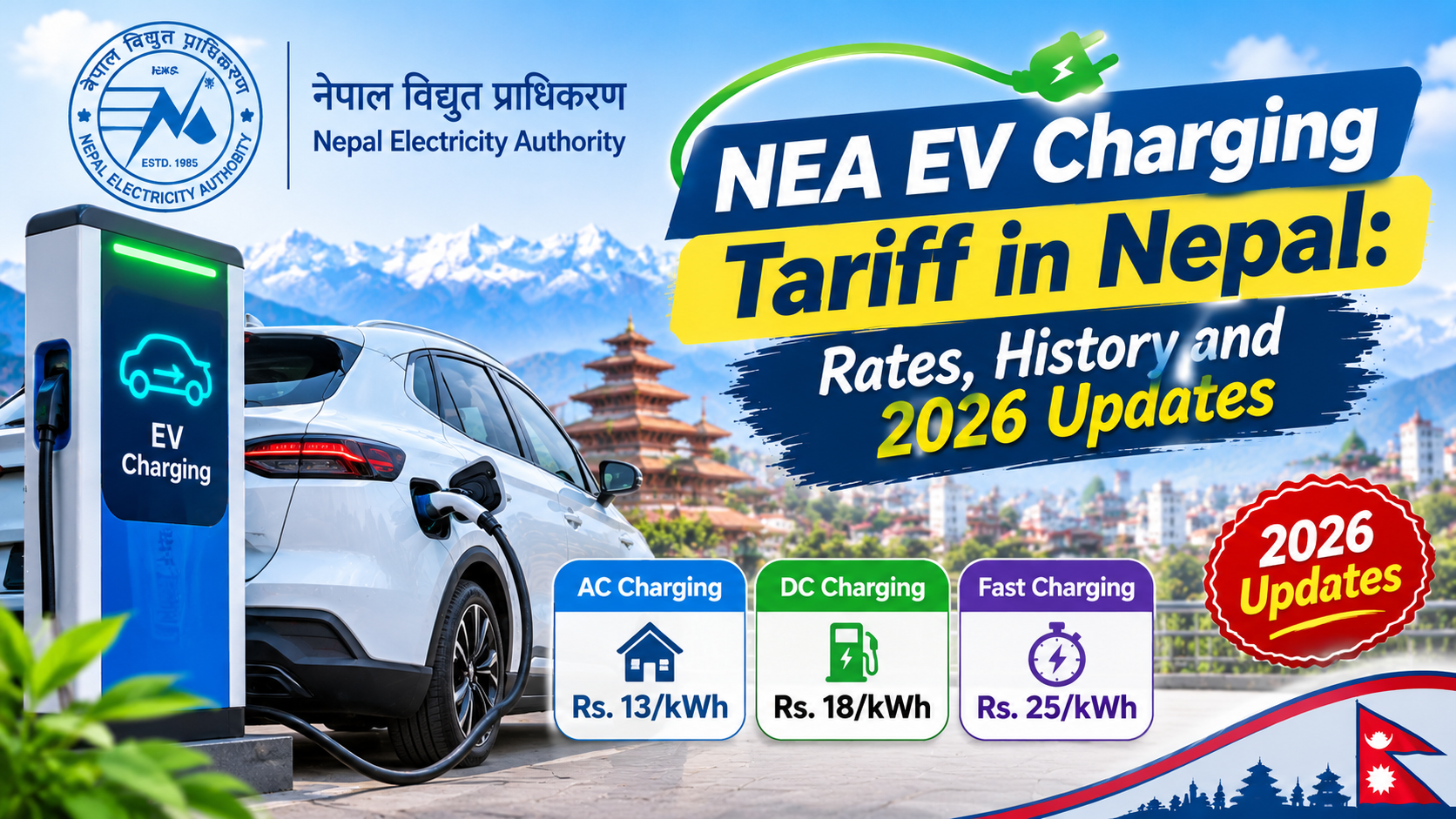
NEA EV charging tariff 2083: what charging stations pay per unit, night and peak rates, and 2026 updates on EV charging cost in Nepal.