
EV News, Buying Guides
Nov 23, 2026
Read Story EV Battery Safety in Nepal: What Buyers Should Check
EV fires and weak battery rules are in the news. Check warranty, certification and charging habits before you buy an electric car in Nepal.
NEA EV charging tariff 2083: what charging stations pay per unit, night and peak rates, and 2026 updates on EV charging cost in Nepal.
Go With EV Editorial
Go With EV Editorial
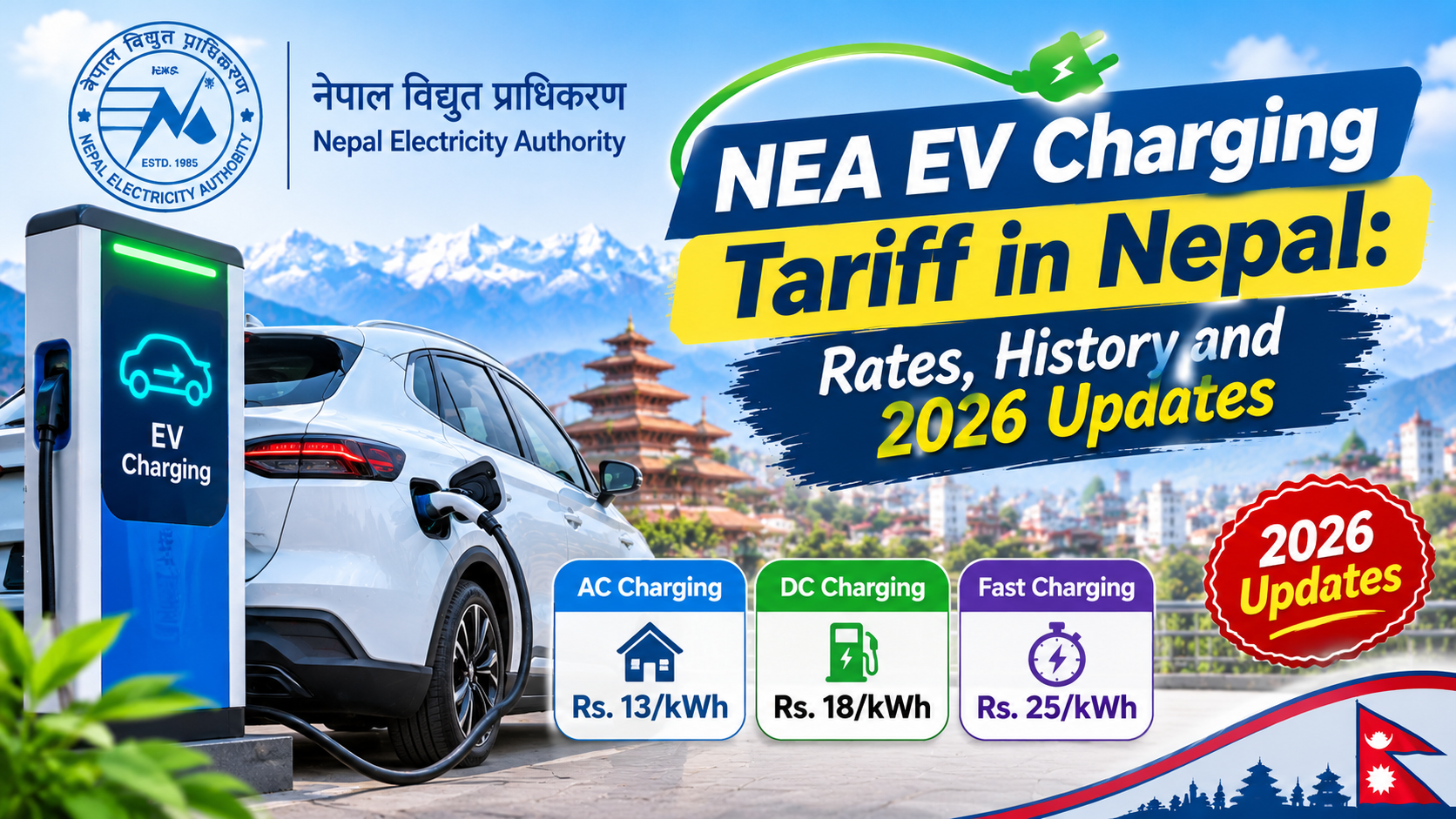
Electric car owners and charging station operators in Nepal both ask the same question: what does the Nepal Electricity Authority (NEA) charge for EV charging electricity? The short answer is that charging stations buy power at a special per-unit rate that depends on the time of day, and they may add up to 20% when they sell it on. The details are less clear. Reports from different dates and sites give different figures, and we could not open the NEA's own tariff schedule. This guide sets out what each source says, what has changed in 2026 (2083 BS), and what is still unconfirmed. It is not a substitute for the official tariff, so check the current rate with NEA or your station.
EV News Nepal lists the following, and says the 20% retail markup is the maximum a station may add. It also says that neither NEA nor private networks publish one retail price, so the ceilings are not the price at a given charger.
Rs per unit (kWh). The 2020 column is the first fixed wet-season rate from the Himalayan Times. The 2021 column and ceilings are from EV News Nepal (checked 14 October 2026).
| Time of day | 2020 first fixed, wet season (Rs/unit) | NEA rate in force since Dec 2021 (Rs/unit) | Retail ceiling (Rs/unit) |
|---|---|---|---|
| Normal (5 am to 5 pm) | 10.10 | 10.30 | 12.36 |
| Peak (5 pm to 11 pm) | 11.20 | 11.70 | 14.04 |
| Off-peak (11 pm to 5 am) | 4.45 | 5.15 | 6.18 |
The Onlinekhabar report from February 2020 gives non-public ranges of Rs 10.10 to 10.30 (daytime), Rs 11.20 to 11.70 (peak) and Rs 4.45 to 5.15 (night) in the wet season, which is consistent with the current figures sitting at the top of each range. It also lists lower rates for public transport charging, between Rs 4.45 and Rs 8.70 per unit, depending on voltage and season. That was a proposal and we have not confirmed it was adopted.
Night or off-peak rate per unit as given by each source.
| Source | Night or off-peak rate (Rs/unit) | Notes |
|---|---|---|
| NERC tariff report, Himalayan Times, 18 Jun 2020 | 4.45 | Wet season, 11 pm to 5 am |
| Ratopati (22 Jun 2026) and Hamropatro (30 Jul 2026) | 4.20 | 11 pm to 5 am; described as the existing special rate |
| EV News Nepal (checked 14 Oct 2026) | 5.15 | NEA rate to station, 11 pm to 5 am |
| Motar (updated 15 Dec 2025) | 6.00 | NEA public charging, 10 pm to 5 am |
The numbers differ for several possible reasons: different dates, a wet-season versus dry-season rate, different voltage categories, or errors in reporting. We cannot tell which. Republica also published an undated article (it shows "October 19" with no year) saying NEA cut its charging station rate from Rs 10 to Rs 4.60 per unit and bus charging from Rs 1,200 to Rs 500 per charge, with stations allowed to add a 20% service charge. Because the year is missing, we have not used it as a current rate. If you run a station, ask NEA for the current schedule in writing.
The FY 2026/27 budget introduced a 5% VAT on household electricity use above 50 units a month. Households using 50 units or less are exempt. EV-Nepal.com reported the change on 18 July 2026 and says NEA's own residential tariff did not change. Hamropatro reported that the tax started from Shrawan 1 and drew protests, and that the finance minister said work was underway to apply it only above 100 to 150 units, while the energy minister's office set up a committee to review electricity tariffs. Neither article says whether the VAT applies to EV charging stations or other commercial customers, so we cannot say how it affects public charging prices.
Ratopati reported on 22 June 2026 that the government is preparing a tariff with cheaper electricity in the monsoon season and demand-based prices in the dry season. The article gives no rates and does not say whether EV charging is covered. It also quotes the regulator's acting executive director saying the process is "technically stalled" because the commission had no office bearers. The article was machine translated, so treat the wording with care.
Charging at home falls under the normal household tariff. For a 15 A single-phase meter, EV-Nepal.com and EV News Nepal both list the same energy charges:
Energy charge per unit for a 15 A meter. Other meter sizes differ, and monthly service charges and the new VAT come on top. Sources: EV-Nepal.com (18 July 2026) and EV News Nepal.
| Monthly units | Energy charge (Rs/unit, 15 A meter) |
|---|---|
| 0 to 20 units | 4.00 |
| 21 to 30 units | 6.50 |
| 31 to 50 units | 8.00 |
| 51 to 250 units | 9.50 |
| Above 250 units | 11.00 |
The rate is by block, and each slab is charged at its own rate, according to EV News Nepal. That means the cost of charging depends on how many units your household already uses. EV-Nepal.com bills a 120-unit month in bands: 20 units at Rs 4.00, 10 at Rs 6.50, 20 at Rs 8.00 and 70 at Rs 9.50. By our calculation that is about Rs 970 in energy charges, before the service charge and VAT, which the article does not total. It also estimates that charging a battery fully once a week uses about 77 units for a 19.2 kWh pack, 120 for 30 kWh, 160 for 40 kWh and 240 for 60 kWh a month. At these figures, adding a weekly full charge pushes a household into the higher slabs. One other site, Motar, lists different slab numbers, so check your own NEA bill.
NEA's January 2022 bylaws also allow a larger separate meter in the home compound when the approved domestic load cannot support charging. The sources we read do not say what tariff applies to that separate meter.
This example uses the retail ceilings from EV News Nepal and ignores charging losses. A 50 kWh charge at the normal-hours ceiling of Rs 12.36 per unit costs about Rs 618. At the peak ceiling of Rs 14.04 it is Rs 702, and at the off-peak ceiling of Rs 6.18 it is about Rs 309. These are maximums, so a station may charge less. Check the price at the charger before you plug in.
See our guide to EV charging stations in Nepal for how many stations there are and where, and compare cars on GoWithEVs.
EV News Nepal lists Rs 10.30 at normal hours, Rs 11.70 at peak and Rs 5.15 off-peak. Other sources report different night rates, so confirm with NEA.
Yes, up to 20% per unit according to Onlinekhabar (2020) and EV News Nepal.
We found no report of a change. A 5% VAT on household electricity above 50 units began with the FY 2026/27 budget, but the sources do not say whether it applies to charging stations.
The normal household tariff. On a 15 A meter it is Rs 9.50 per unit for 51 to 250 units a month and Rs 11 above 250, before VAT and service charges.
Yes, between 11 pm and 5 am, though sources give different amounts from Rs 4.20 to Rs 6.00.
Note: Tariff may change so please visit the NEA official website also.
Explore trending electric vehicle news and upcoming launches
EV fires and weak battery rules are in the news. Check warranty, certification and charging habits before you buy an electric car in Nepal.

Best selling electric cars in India October 2026: Tata Punch EV, Mahindra XEV 9S, Nexon EV, Windsor EV sales, registrations and EV market share.

List of BYD model sold in Nepal, from the Atto 1 at NPR 30.75 lakh to the Seal, with prices, battery, range and price changes since 2025.