
EV News, Buying Guides
Nov 23, 2026
Read Story EV Battery Safety in Nepal: What Buyers Should Check
EV fires and weak battery rules are in the news. Check warranty, certification and charging habits before you buy an electric car in Nepal.
Nepal’s 2026/27 budget replaced the motor-power EV excise with a value-based fee of 2.5% to 130%. See the old and new rates, charts and price impacts.
Go With EV Editorial
Go With EV Editorial
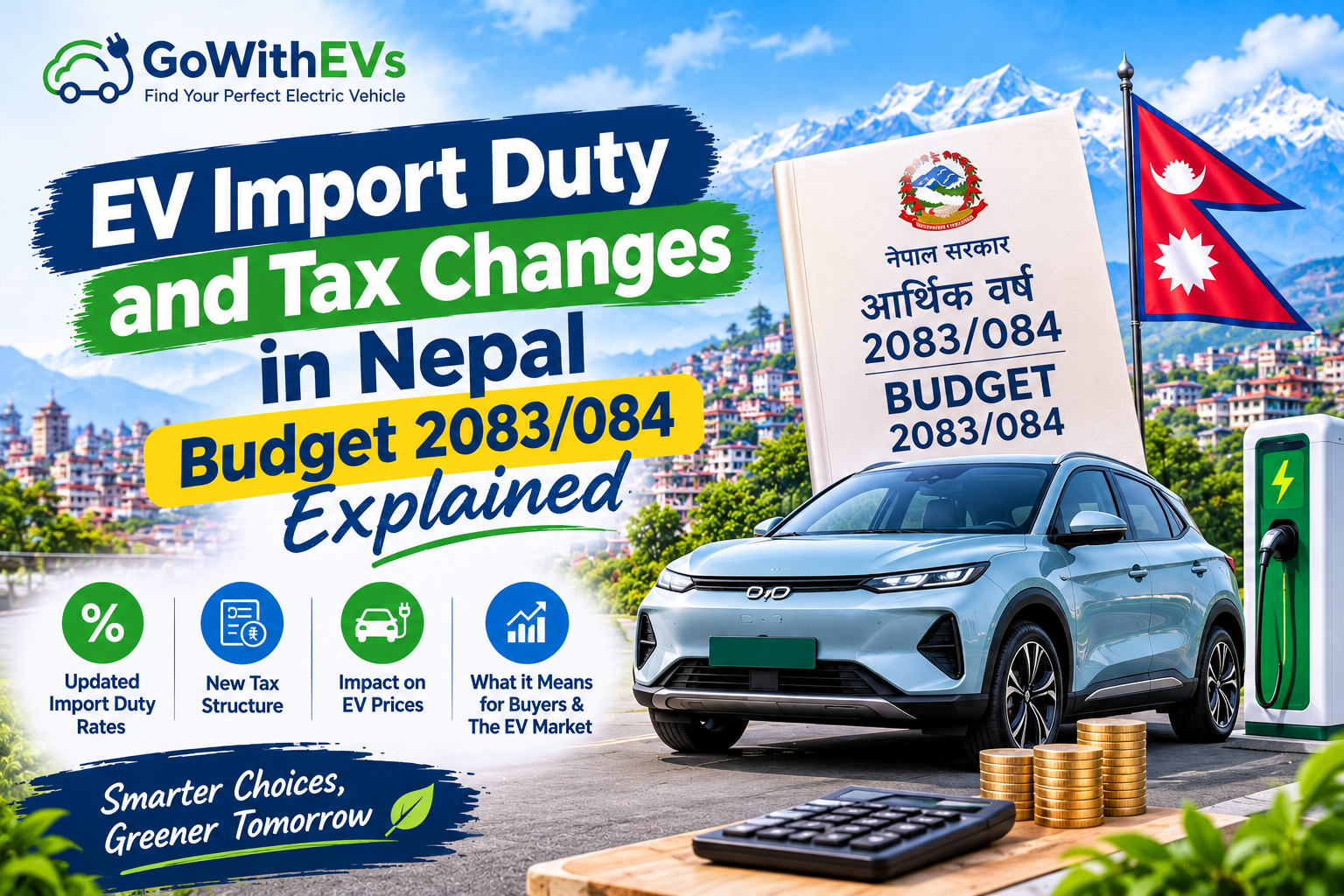
Nepal's budget for fiscal year 2026/27, presented on 29 May 2026, changed how electric vehicles are taxed at the border. The old system charged customs and excise duty by motor power in kilowatts. The new one drops excise duty and adds a Clean Infrastructure Investment Fee (CIIF) that depends on the vehicle's value. This guide explains the old rates, the new rates, what has changed for each price band, and how listed prices have moved since. Rates below come from news reports of the budget and the finance ministry's clarification, not from the Finance Act text, so check the current schedule with a dealer or customs agent before you buy.
| Date | What happened |
|---|---|
| 29 May 2025 | FY 2025/26 budget kept all EV taxes and duties unchanged. |
| 6 to 27 May 2026 | Cimex says its vehicles were cleared by customs in this window, before the budget. |
| 29 May 2026 | Finance Minister Swarnim Wagle presents the FY 2026/27 budget with value-based EV duties. |
| 31 May 2026 | The ministry's clarification gives the fee slabs and the formula. |
| 3 June 2026 | A Finance Bill amendment exempts EVs imported before the budget but not yet registered from the fee, if they already paid import duties. Meroauto does not say whether it has been enacted. |
| 5 June 2026 | Reports of the Armed Police Force seizing 776 EVs. |
Under the FY 2025/26 budget, EV import duty depended on motor capacity. The higher the kilowatt rating, the higher the customs and excise rates. The finance minister said at the time that all taxes and duties on such vehicles would be kept unchanged. VAT (13%) and the road fee (5%) applied on top of these figures.
Customs and excise duty by motor capacity, FY 2025/26. Source: Nepal Drives (budget report, 29 May 2025).
| Motor power | Customs duty | Excise duty | Customs + excise |
|---|---|---|---|
| Up to 50 kW | 15% | 5% | 20% |
| 51–100 kW | 20% | 15% | 35% |
| 101–200 kW | 30% | 20% | 50% |
| 201–300 kW | 60% | 35% | 95% |
| Above 300 kW | 80% | 50% | 130% |
A car in the 101 to 200 kW band paid a combined 50% in customs and excise, and one above 300 kW paid 130%. Meroauto reports that the old total for the 100 to 200 kW band, including the road fee and VAT, came to about 85%.
Kathmandu Post reports that the old system based the tax on motor peak power, which let importers declare a lower peak power and get a lower rate. The new system uses the customs value in rupees. A headline on Nepalevs.com says derating a car to 99 kW no longer saves any money under the new tax, which points to the same trick. No named government official is quoted in the Kathmandu Post article defending the change, so the reason above is the paper's description of how the old rule worked, not an official statement.
The budget replaced excise duty with the Clean Infrastructure Investment Fee. According to the Kathmandu Post, the fee is calculated on the customs value. Meroauto's reading of the ministry clarification is that the customs value is the CIF value plus the customs duty. The budget describes the fee as funding domestic EV production, charging stations and battery management, though the article does not give its rate by purpose.
Fee rate by customs value. Sources: Kathmandu Post, Meroauto (31 May 2026).
| Customs value | Fee rate |
|---|---|
| Up to Rs 2 million | 2.5% |
| Rs 2–3 million | 20% |
| Rs 3–4 million | 35% |
| Rs 4–5 million | 90% |
| Above Rs 5 million | 130% |
Other charges that continue:
Two things stand out in the slabs. First, the jump from 35% to 90% between the Rs 3 to 4 million and Rs 4 to 5 million bands is steep. Bishnu Kumar Agrawal of MAW Group called the move from 35% to 90% and then 130% "too large." Second, because the bands are set in rupees, exchange-rate moves can shift a vehicle from one band to the next, a concern the Kathmandu Post raised.
For CIF values up to Rs 2 million, Meroauto reports the total tax burden fell from 43.27% to 42.46%, a drop of about 0.81 percentage points. For a hypothetical EV with a CIF value of Rs 1.95 million, the customs-cleared value went from about Rs 2.794 million to about Rs 2.779 million. Meroauto lists the Tata Tiago EV, BYD Atto 1 (Standard), Dongfeng Nammi box and several mini EVs such as the MG Comet EV as models that should stay affordable, though it gives no prices.
Another Meroauto report looks at the up to 50 kW band under the old rules: customs 15% and excise 5% before, against 20% customs and a 2.5% fee now. It puts the stated total at 38% before and 40.5% now, and says small EVs could cost about 3% more. Cimex told the Kathmandu Post the Atto 1 starting price could rise to about Rs 3.1 million, with higher variants near Rs 3.6 million. Different reports disagree on how much entry-level prices will move, which is one more reason to ask for a written quote.
Meroauto worked through this band in detail. Old rates were 20% customs, 15% excise, 5% road fee and 13% VAT, which it lists as 53% in total. The new rates are 20% customs, a 20% fee, 5% road fee and 13% VAT, listed as 58%. Calculated step by step, it puts the burden at about 63.73% before and 70.85% after. For a car with a CIF value of Rs 2.5 million, it estimates the final price moves from about Rs 4.093 million to about Rs 4.271 million, a rise of roughly Rs 178,000, before dealer margins. It expects the BYD Atto 2, MG S5, Deepal S05, iCAUR V23 and Leapmotor B10 to rise by about Rs 200,000 to Rs 250,000. Listed prices after the change are charted below.
The fee rises to 35% and then 90%. For a vehicle above Rs 4 million CIF, Meroauto reports 20% customs, a 90% fee, 5% road fee and 13% VAT, an effective burden of about 170%. In its worked example for the Rs 4 to 5 million bracket, the total tax moves from about 85% to about 171%. Meroauto notes that its two examples use different CIF values and do not match each other exactly, so treat them as rough illustrations.
Meroauto puts the total tax incidence at the top slab at 227%, and another of its reports says up to 230%. SPG Automobiles estimates that vehicles selling at Rs 6 to 7 million will pay an extra Rs 2 to 2.5 million in tax, taking the final price above Rs 9 million or Rs 9.5 million. Meroauto's June report says models around Rs 7.5 million, such as the IM6 and Deepal S07, may move past Rs 10 million, and the Avatr 11, currently listed at Rs 10.45 million, could exceed Rs 20 million depending on the final calculation and importer pricing. Those are estimates and not confirmed prices.
Change in listed price in NPR lakh, from EV News Nepal's 13 July 2026 comparison. Where a model has a price range, the change applies to both ends. Not shown: the Maxus MIFA 7 (Rs 1.25 crore to Rs 2.45 crore) and the BMW iX1 (Rs 2.00 crore to Rs 3.30 crore), which rose far more than the others.
| Model | Old → new price (NPR lakh) | Change (lakh) |
|---|---|---|
| Proton e.Mas 7 | 46.99–57.99 → 56.99–67.99 | +10 |
| Deepal S05 | 53.99–59.99 → 57.99–62.99 | +4 |
| Atto 2 | 45.99 → 48.99 | +3 |
| iCAUR V23 | 50.99 → 53.99 | +3 |
| Geely EX5 Max | 70 → 73 | +3 |
| Geely EX5 Pro | 59 → 62 | +3 |
| MG IM6 | 78.99 → 81.99 | +3 |
| Atto 3 Advanced | 59.99 → 61.99 | +2 |
| MG S6 | 69.99 → 71.99 | +2 |
| MG S5 Luxury | 49.99–54.99 → 50.99–55.99 | +1 |
| Suzuki e-Vitara | 49.99 → 48.99 | -1 |
| Leapmotor B10 | 60 → 54.99 | -5.01 |
Most mid-range models rose by Rs 1 to 4 lakh, while the Proton e.Mas 7 rose by Rs 10 lakh. Two models went down: the Leapmotor B10 by about Rs 5 lakh and the Suzuki e-Vitara by Rs 1 lakh. EV News Nepal attributes two-wheeler price changes to exchange rates, not tax, so those are left out of the chart.
EV importers have stocked up before budgets in earlier years. Meroauto reported in May 2025 that Nepal imported 7,967 EVs in the first nine months of that fiscal year, and that importers had brought in about 5,000 EVs in the six weeks before the previous year's budget. Importers were expecting a duty increase and stocking up at the old rates.
In 2026 the rush ended in a legal dispute. The Armed Police Force seized 776 EVs, mostly BYD models: 774 came through Korala in Mustang and 2 through Rasuwagadhi. The APF said it acted on information that fraudulent documents were used. The Kathmandu Post says it has not established whether any leak of the tax plan occurred. Mustang customs says 649 vehicles were cleared on 26 and 27 May. Cimex says all procedures followed Nepal's laws and that it will cooperate. An anonymous importer told the paper that importing at the prevailing rates until the night before the budget "is completely legal." The finance ministry is leading the inquiry, and the prime minister's office directed it to increase EV import monitoring.
The Kathmandu Post also raised the concern that sharp jumps between slabs could make many premium EVs commercially unviable.
If you are shopping for an EV under about Rs 2 million CIF, the tax change is small, and the listed prices for most of these models moved only slightly. If your car is in the Rs 2 to 3 million band, expect a rise in the range of Rs 1 to 4 lakh based on the listings above. Above Rs 4 million, the fee dominates the price, and the quote you get may depend on the exchange rate on the day. Ask the dealer whether the quoted price already includes the fee, which customs value it is based on, and whether the vehicle was imported before the budget. A pre-budget carthat is not yet registered may be exempt from the fee under the amendment, but confirm that in writing. Compare prices on GoWithEVs alongside the specs.
It is a value-based fee on imported EVs that replaced excise duty in the FY 2026/27 budget. It is charged on the customs value, with rates from 2.5% to 130%.
Yes. Reports say customs duty is a flat 20% for all EVs, regardless of motor power or price.
The road construction fee is 5%, and the finance minister cut it to 2.5% for EVs under Rs 2 million.
A Finance Bill amendment exempts EVs imported before the budget but not yet registered from the fee, if they already paid import duties. Meroauto does not say whether the amendment has passed.
In EV News Nepal's comparison, the Leapmotor B10 fell from Rs 60 lakh to Rs 54.99 lakh and the Suzuki e-Vitara from Rs 49.99 lakh to Rs 48.99 lakh.
Explore trending electric vehicle news and upcoming launches
EV fires and weak battery rules are in the news. Check warranty, certification and charging habits before you buy an electric car in Nepal.
Best selling electric cars in India October 2026: Tata Punch EV, Mahindra XEV 9S, Nexon EV, Windsor EV sales, registrations and EV market share.
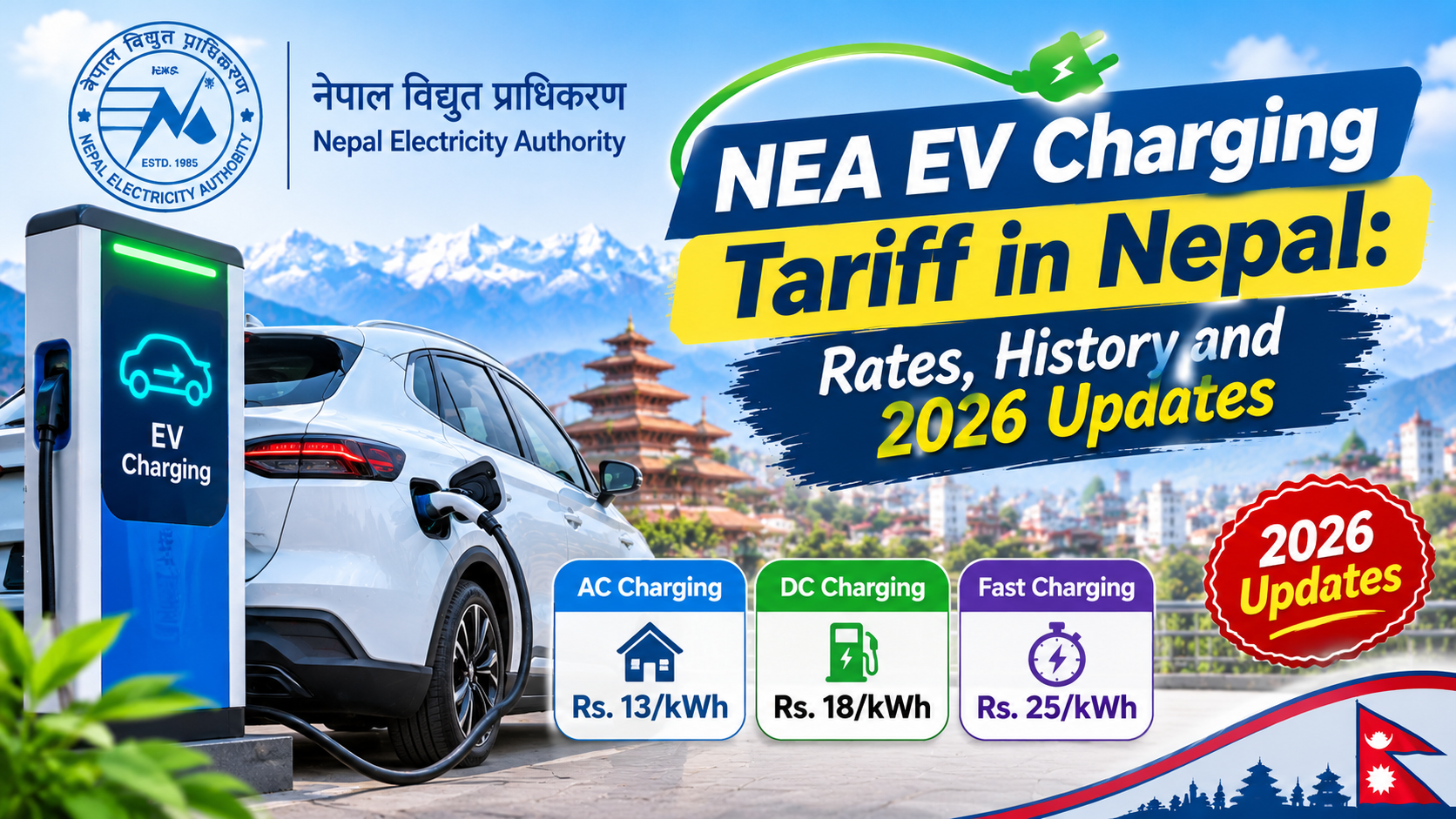
NEA EV charging tariff 2083: what charging stations pay per unit, night and peak rates, and 2026 updates on EV charging cost in Nepal.